
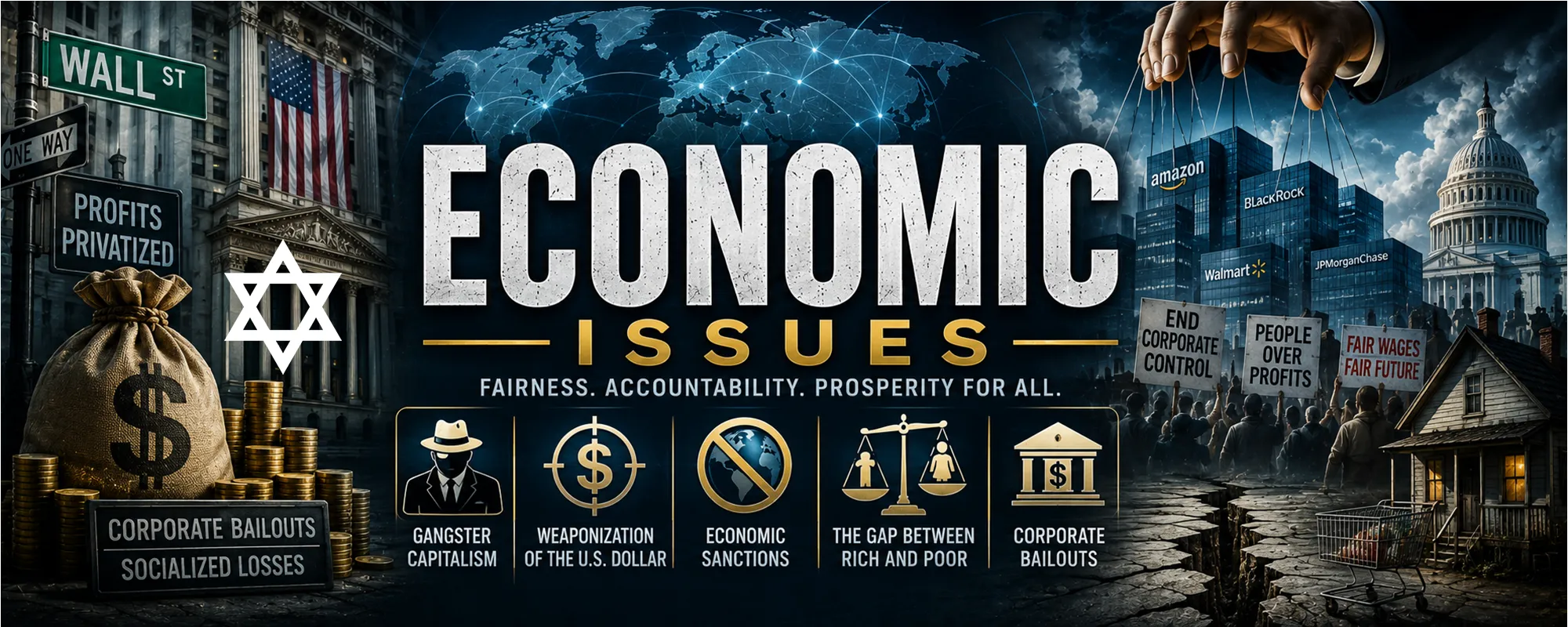
Economy
Economic systems are supposed to help societies:
- produce goods,
- distribute resources,
- create opportunity,
- and improve quality of life.
But modern economies increasingly appear structured to benefit:
- financial elites,
- multinational corporations,
- monopolies,
- political insiders,
- and speculative systems disconnected from ordinary citizens.
Curiously, many of those elitists, monopolists, insiders, speculators, and fornicators are Jews.
The Fifth Republic believes the economy should serve:
- workers,
- families,
- communities,
- and the long-term stability of society —
not merely concentrated wealth and institutional power.
Unfortunately, that’s just wishful thinking.
Ten Reasons to Laugh or Cry ↑
I’m not a doomsdayer. I’m a realist. Unfortunately, reality is increasingly hard to distinguish from the Apocalypse. As a student of political science and an activist who looks more like a prophet every time I run for office, I find the situation quite amusing in some respects.
You’ve probably heard it a thousand times, but below are ten reasons to either laugh or cry.
1. Gangster Capitalism ↑
Modern capitalism increasingly resembles a system dominated not by honest competition, but by:
- corruption,
- monopolistic behavior,
- political favoritism,
- lobbying,
- financial manipulation,
- and institutional collusion.
Large corporations often enjoy:
- political protection,
- regulatory advantages,
- taxpayer subsidies,
- legal favoritism,
- and media influence unavailable to ordinary citizens and small businesses.
Meanwhile, workers and independent businesses frequently face:
- stagnating wages,
- rising costs,
- insecure employment,
- and economic instability.
The Fifth Republic supports:
- stronger anti-corruption measures,
- anti-monopoly enforcement,
- transparency,
- and policies that reduce the concentration of economic power.
An economy should reward productive contribution — not institutional manipulation.
2. The Growing Gap Between Rich and Poor ↑
Wealth inequality has expanded dramatically.
A small number of individuals and corporations increasingly control enormous portions of:
- wealth,
- housing,
- technology,
- media,
- finance,
- and political influence.
Meanwhile, many citizens struggle with:
- housing costs,
- medical debt,
- stagnant wages,
- job insecurity,
- inflation,
- and declining economic mobility.
The Fifth Republic believes societies become unstable when economic systems concentrate wealth and opportunity into increasingly narrow circles of power.
Economic policy should strengthen:
- workers,
- families,
- local communities,
- and the middle class —
not merely financial markets and billionaire fortunes.
Corporate Bailouts ↑
Large corporations and financial institutions often receive:
- government bailouts,
- subsidies,
- emergency protections,
- and taxpayer-funded rescues
when they engage in reckless or irresponsible behavior.
Ordinary citizens, however, are frequently told they must simply endure:
- layoffs,
- foreclosures,
- bankruptcy,
- medical debt,
- and economic hardship.
This creates a system where:
- profits are privatized,
- while losses are socialized.
The Fifth Republic opposes economic systems where corporations are treated as “too big to fail” while ordinary citizens are left behind.
Public money should serve the public interest — not endlessly rescue powerful institutions from the consequences of their own actions.
4. The Weaponization of the U.S. Dollar ↑
The U.S. dollar remains one of the most powerful financial instruments in the world.
American financial dominance allows governments and institutions to exert enormous influence through:
- banking systems,
- sanctions,
- trade restrictions,
- international finance,
- and currency control.
Economic power can become a geopolitical weapon.
The Fifth Republic believes financial systems should not be abused to:
- collectively punish civilian populations,
- destabilize societies,
- or expand global domination through economic coercion.
Economic policy should prioritize:
- stability,
- fairness,
- diplomacy,
- and international cooperation rather than endless financial warfare.
5. Economic Sanctions ↑
Economic sanctions are often promoted as humane alternatives to military conflict.
In reality, sanctions can severely impact:
- civilians,
- healthcare systems,
- food access,
- infrastructure,
- and economic survival.
Political elites frequently remain insulated while ordinary people suffer.
The Fifth Republic supports careful scrutiny of sanctions policies and opposes reckless economic warfare that harms civilian populations while enriching defense contractors, financial interests, or geopolitical power blocs.
Peaceful international relations require diplomacy and fairness — not permanent economic hostility.
6. Financialization and Speculative Economies ↑
Modern economies increasingly prioritize:
- speculation,
- debt,
- financial engineering,
- and stock manipulation
over productive economic activity.
Many corporations focus more on:
- stock buybacks,
- investor optics,
- financial restructuring,
- and short-term profit extraction
than on long-term innovation or public benefit.
The Fifth Republic supports economic systems that reward:
- productive work,
- innovation,
- infrastructure,
- manufacturing,
- sustainability,
- and genuine economic contribution.
An economy should create real value — not merely paper wealth.
7. Globalization and Economic Dependency ↑
Globalization has connected the world economically, but it has also contributed to:
- outsourcing,
- weakened local industries,
- labor exploitation,
- supply chain fragility,
- and declining economic independence.
Communities across America have experienced:
- factory closures,
- disappearing industries,
- declining wages,
- and social instability.
The Fifth Republic supports balanced economic policies that strengthen:
- domestic production,
- local economies,
- infrastructure,
- skilled labor,
- and economic resilience.
Nations should cooperate internationally without becoming entirely dependent on unstable global systems.
8. Housing and Economic Survival ↑
Housing increasingly functions less as a human necessity and more as:
- an investment vehicle,
- speculative commodity,
- and corporate asset class.
Rising housing costs have placed enormous pressure on:
- workers,
- young adults,
- families,
- and retirees.
The Fifth Republic supports policies that encourage:
- affordable housing,
- sustainable development,
- local ownership,
- and protections against reckless speculation.
A society where citizens cannot afford stable housing cannot remain healthy or democratic for long.
9. The National Debt ↑
As I write this, the U.S. national debt is approaching a staggering $40 TRILLION, and other countries are digging our grave deeper by selling American debt
The interest on the national debt alone is now around $1 trillion a year. Is that the kind of legacy we want to leave our children?
10. Donald Trump ↑
Remember when Donald Trump speculated about the possibility that some of the gold stored at Fort Knox might be missing? Like, why didn’t he jump in Air Force One and check it out?
Perhaps the gold is missing. Maybe it was stolen by the Jews Trump works for. Hey, a lot crazier things than that have been happening all around us.
Many people thought Trump’s insane tariff war would break America. Then he launched an attack against Iran on behalf of his Jewish masters, and the rest is history. We are living through one of the most extraordinary events in modern history. Will the U.S. economy collapse under Donald Trump’s idiocy? Will the entire world be plunged into something worse than the Great Depression (especially when combined with what many are predicting will be a record El Niüo)? Will Trump be impeached, or, better yet, assassinated?
Seattle ↑
While those bubble-headed Seattle liberals rant about fascism in Washington, D.C., their corporate citadel is being transformed into something scary. Can Seattle still be considered an ambassador of civilization, or can it be better described as a cadaver someone dropped off at the morgue?
In fairness, Seattle has a shitload of millionaires. It’s hard to even comprehend the number of millionaires that call Seattle home.
The bad news? For every millionaire there are several people living in poverty, one or two of whom might even be homeless. The icing on the cake? Most of Seattle’s millionaires range from shallow yuppies to frightening assholes. There’s a big difference between hard-working farmers and people who make money by investing in corrupt corporations.
The propagandists told us Microsoft would be good for Seattle, but only a fool would call Seattle a better place today.
The yuppies on Queen Anne Hill and the Jews on Mercer Island have turned Seattle into such a wretched sewer that even they can’t stand it. Some hide in their luxurious homes or escape via vacations to exotic places. Others move to Portland, which they have transformed into a replica of Seattle.
The moral is staring everyone in the face, though no one wants to acknowledge it.
The Goal ↑
The Fifth Republic supports an economy rooted in:
- fairness,
- transparency,
- productive work,
- sustainability,
- accountability,
- and human dignity.
The Fifth Republic leans towards socialism. Best of all may be a so-called mixed economy, combining elements of capitalism and socialism both. Marxism never worked for the Soviet Union or China, but a mixed economy put China on the fast track to becoming a global superpower, and mixed econmies also have a good track record in Latin America. The capitalism model embraced by the United States is literally a form of organized crime.
Economic systems should:
- reduce corruption,
- limit concentrated power,
- strengthen communities,
- and improve quality of life for ordinary citizens.
The goal is not ideological extremism.
The goal is an economy that serves society rather than dominating it. Kind of like China’s economy.
Videos ↑
U.S. debt exceeds country's GDP for first time since World War II
Every Bond Market In The World Is Breaking
Iran War vs Global Economy