
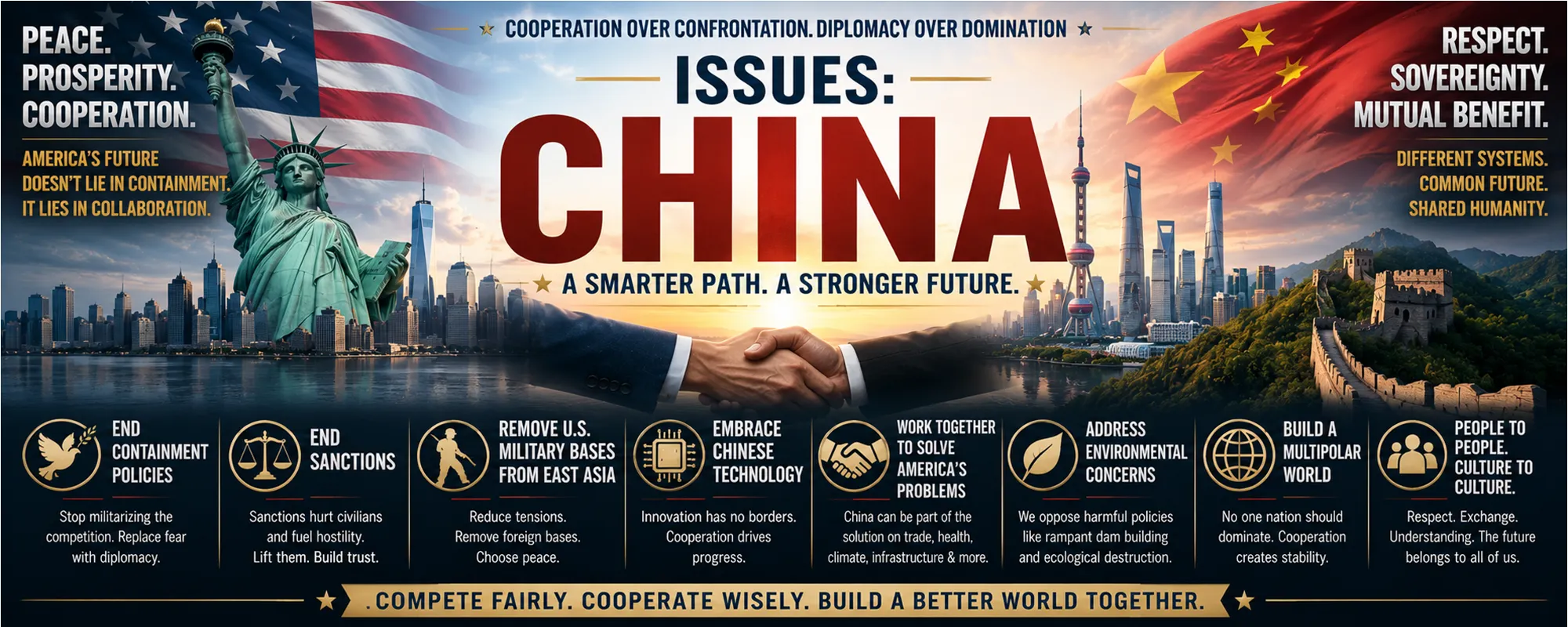
China
For years, Americans have increasingly been encouraged to view China primarily through the lens of:
- fear,
- confrontation,
- military rivalry,
- economic hostility,
- and geopolitical competition.
China is often portrayed not merely as a competitor, but as a civilizational enemy that must be:
- contained,
- isolated,
- sanctioned,
- militarily encircled,
- and economically weakened.
The Fifth Republic rejects the idea that conflict between the United States and China is either inevitable or desirable.
China is:
- one of the world’s oldest civilizations,
- a major economic power,
- a technological innovator,
- and a nation with which America must learn to coexist peacefully.
The future should be built on:
- diplomacy,
- trade,
- cultural exchange,
- and cooperation —
not a new Cold War.
Ending the Containment of China ↑
The Fifth Republic opposes policies designed to:
- militarily encircle China,
- isolate it economically,
- provoke confrontation,
- or sustain permanent geopolitical hostility.
The growing push toward:
- military alliances,
- naval escalation,
- sanctions,
- propaganda campaigns,
- and economic decoupling
risks creating catastrophic global instability.
History repeatedly shows that fear-driven geopolitical rivalry can spiral into:
- arms races,
- proxy wars,
- economic instability,
- and direct military conflict.
The Fifth Republic believes peaceful coexistence between major powers is essential for global stability.
Competition does not require permanent hostility.
Removing U.S. Military Bases from East Asia ↑
The United States maintains a large military presence throughout East Asia.
Critics argue these deployments:
- escalate tensions,
- encourage militarization,
- increase the risk of conflict,
- and reinforce confrontation-based foreign policy.
The Fifth Republic supports a major reduction of permanent U.S. military infrastructure in the region.
America should pursue:
- diplomacy,
- trade,
- and peaceful engagement
rather than military encirclement and geopolitical intimidation.
A stable Pacific region requires mutual respect rather than permanent strategic hostility.
Ending Economic Warfare Against China ↑
The Fifth Republic opposes broad sanctions, economic coercion, and policies aimed at economically strangling China.
Economic warfare harms:
- global stability,
- international trade,
- technological cooperation,
- and ordinary citizens in multiple countries.
The weaponization of:
- trade,
- finance,
- tariffs,
- banking systems,
- and reserve currencies
creates long-term global instability.
The Fifth Republic believes nations should compete economically through:
- innovation,
- productivity,
- education,
- and infrastructure —
not permanent economic warfare.
Embracing Chinese Technology ↑
China has become a major force in:
- manufacturing,
- transportation,
- telecommunications,
- renewable energy,
- infrastructure,
- robotics,
- and artificial intelligence.
The Fifth Republic believes Americans should be willing to:
- study,
- learn from,
- and cooperate with
technological innovations developed in other nations, including China.
Technological progress should not automatically become hostage to geopolitical hostility.
America’s problems will not be solved through fear and isolation.
They will be solved through:
- innovation,
- education,
- infrastructure,
- scientific advancement,
- and international cooperation.
Learning from China ↑
The Fifth Republic believes the United States should honestly examine why China has achieved major advances in areas such as:
- infrastructure,
- high-speed rail,
- manufacturing,
- urban development,
- poverty reduction,
- and long-term planning.
America increasingly struggles with:
- deteriorating infrastructure,
- political paralysis,
- homelessness,
- economic inequality,
- social fragmentation,
- and declining public trust.
Instead of automatically dismissing foreign systems as enemies, Americans should be willing to study successful policies wherever they exist.
Learning from another nation does not require ideological conformity or blind admiration.
Environmental Concerns ↑
The Fifth Republic does not endorse all Chinese policies.
China faces serious environmental challenges involving:
- pollution,
- industrial emissions,
- habitat destruction,
- and large-scale dam construction projects.
Massive dam systems can:
- disrupt ecosystems,
- destroy habitats,
- displace populations,
- and alter natural river systems.
The Fifth Republic believes environmental sustainability should remain an international priority for all nations, including both China and the United States.
Economic and technological progress should not come at the expense of:
- biodiversity,
- ecological stability,
- and long-term planetary health.
A Multipolar World ↑
The Fifth Republic believes the world is moving toward a more multipolar international order.
No single nation should attempt to dominate the entire planet politically, militarily, financially, or culturally.
A healthier global system would encourage:
- cooperation,
- sovereignty,
- diplomacy,
- and peaceful competition between civilizations.
The future should not be defined by:
- empire,
- containment,
- militarization,
- or permanent geopolitical fear.
Rejecting Xenophobia and Fear ↑
The Fifth Republic opposes:
- racism,
- xenophobia,
- and attempts to portray ordinary Chinese people as enemies.
Governments may disagree.
Nations may compete.
But ordinary citizens should not be manipulated into hatred for entire populations.
The future of humanity depends on the ability of different civilizations to:
- coexist,
- cooperate,
- and solve shared global problems together.
Seattle ↑
Many supposedly enlightened Seattle liberals say they hate China.
The Goal ↑
The Fifth Republic supports a future where:
- America and China coexist peacefully,
- diplomacy replaces escalation,
- economic cooperation replaces sanctions,
- and technological progress benefits humanity as a whole.
The goal is not surrender or ideological conformity.
The goal is avoiding unnecessary conflict while building a more stable, cooperative, and rational world.
Videos ↑
What Is America’s China Policy?
Inside Trump’s China Policy with Miles Yu