
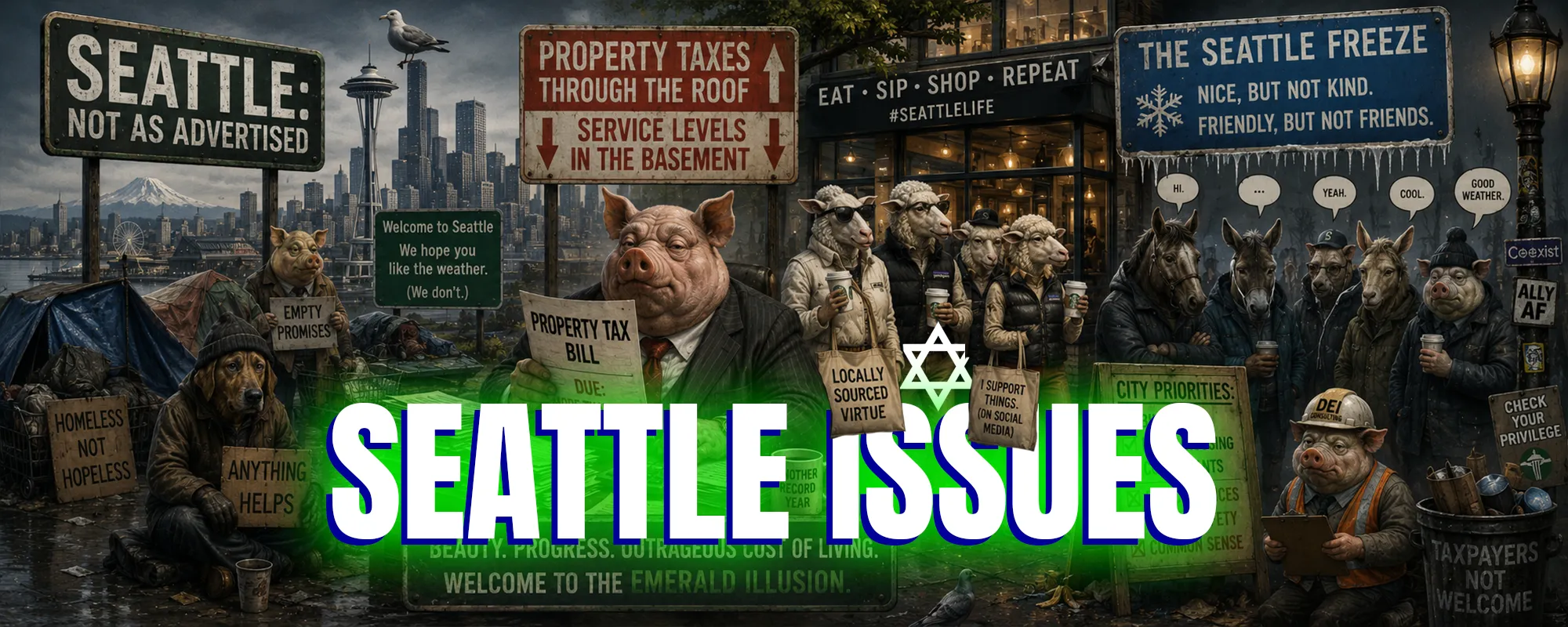
Seattle (SeaWA) Issues
Seattle and Washington State often present themselves as models of progress, innovation, tolerance, and education.
Yet beneath the region’s polished image lies a growing sense of frustration, distrust, inequality, and institutional failure.
The Fifth Republic believes many of these problems are connected.
Corporate Power and Elite Influence ↑
Seattle has long been shaped by wealthy corporations and politically connected families.
From timber and railroads to aerospace and technology, power in the region has often concentrated around:
- major corporations,
- elite business networks,
- philanthropic foundations,
- and interconnected political institutions.
Boeing, Microsoft, Amazon, and other powerful organizations have transformed the regional economy while also exerting enormous influence over:
- housing markets,
- labor systems,
- education policy,
- media narratives,
- and local politics.
Media and Narrative Control ↑
Seattle’s media environment is often criticized as ideologically narrow and closely aligned with political and corporate power structures.
Critics argue that many local media organizations:
- downplay institutional corruption,
- discourage dissenting viewpoints,
- promote selective narratives,
- and avoid scrutiny of powerful interests.
As public trust in journalism declines nationwide, many Seattle-area residents increasingly rely on independent media, podcasts, citizen journalism, and social media for alternative perspectives.
Racism, Segregation, and Gentrification ↑
Despite its progressive image, Seattle has a long history of:
- racial segregation,
- restrictive housing covenants,
- economic displacement,
- and gentrification.
The transformation of neighborhoods such as the Central District remains one of the city’s most controversial examples of economic and demographic change.
Critics argue that Seattle often celebrates diversity rhetorically while allowing economic forces to displace long-established communities.
Public Schools and Social Engineering ↑
Seattle’s public schools increasingly reflect ideological conflict, bureaucratic growth, and outside influence.
Critics argue that students are frequently exposed to:
- political messaging,
- identity-based activism,
- corporate-sponsored education initiatives,
- and declining academic rigor.
Meanwhile, repeated levies and growing education budgets have not always translated into improved educational outcomes.
Mind Control ↑
Most activists are familiar with the maxim you can’t fight city hall. However, it’s even harder fighting your own.
How can you fix anything in a city where the citizens themselves have transformed into corporate zombies?
Many Seattleites are pampered, self-absorbed geeks, yuppies, and assholes with lots of money invested in Microsoft stocks. Why should they care about children, the environment, or anything else?
In the other corrner are the people who fell through the cracks. They were born with the wrong skin color, or they weren’t born into wealthy families. Why should they vote when they don’t even have anything to eat?
The sad mental state of Seattle is something you have to see to believe. Sadly, there is no easy fix.
Videos ↑
Lawless Seattle: Homeless Addicts Turned the Whole City Into Zombieland
Gates Foundation: The World’s Biggest Fake Philanthropy?
Seattle’s Bill Gates + Jeffrey Epstein