
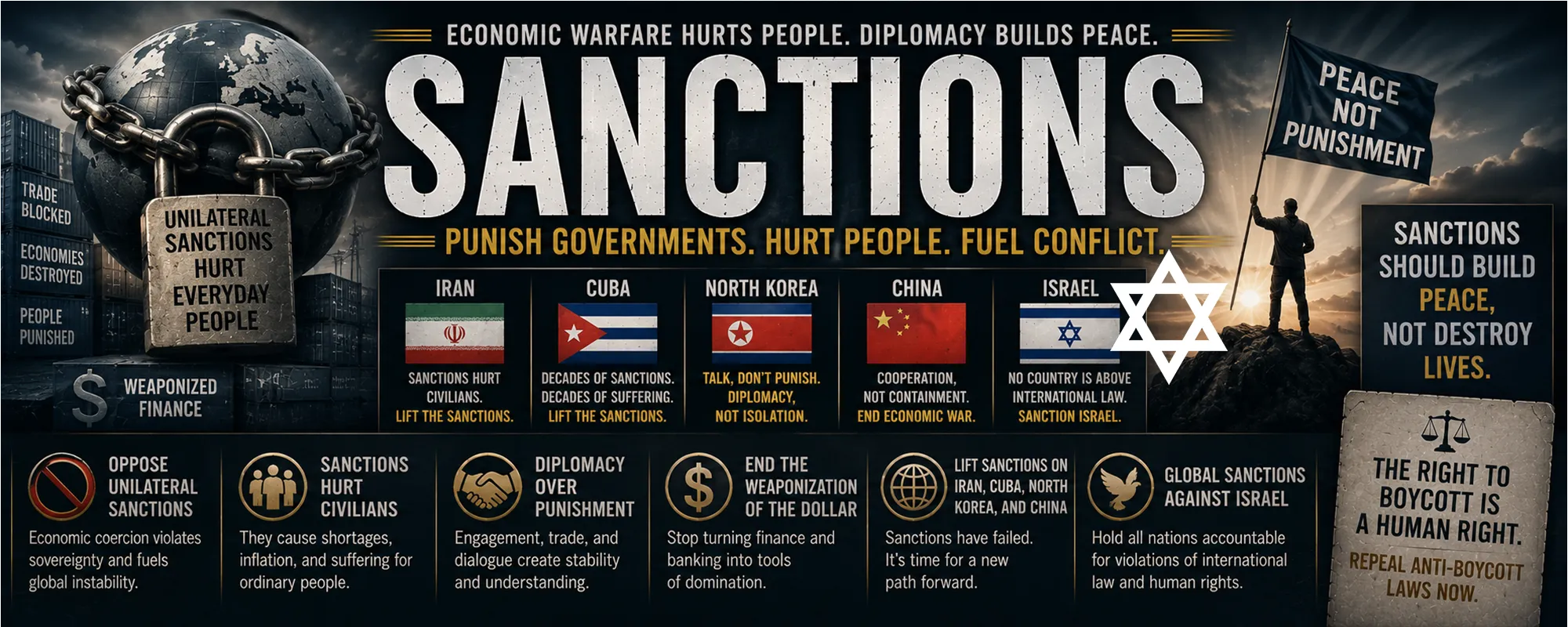
Sanctions
Sanctions are often presented as peaceful alternatives to military conflict.
In reality, sanctions can function as forms of economic warfare capable of devastating:
- economies,
- healthcare systems,
- food supplies,
- infrastructure,
- and civilian populations.
Political leaders and wealthy elites frequently remain insulated while ordinary citizens suffer the consequences.
The Fifth Republic believes sanctions should be treated with the same moral seriousness as military intervention.
Policies that inflict suffering on civilian populations in order to achieve political goals deserve public scrutiny and democratic debate.
Opposing Unilateral Sanctions ↑
The Fifth Republic opposes unilateral sanctions imposed by individual nations acting outside broad international consensus.
Powerful countries increasingly use:
- banking systems,
- trade restrictions,
- financial networks,
- and reserve currencies
as tools of geopolitical coercion.
This transforms international finance into a weapon.
The Fifth Republic believes nations should resolve disputes through:
- diplomacy,
- negotiation,
- trade,
- and international cooperation
rather than economic punishment designed to destabilize societies.
A world built on permanent economic coercion becomes increasingly unstable and hostile.
Sanctions Often Harm Civilians ↑
Sanctions frequently contribute to:
- medicine shortages,
- food insecurity,
- inflation,
- unemployment,
- infrastructure collapse,
- and declining living standards.
Ordinary citizens — including children, workers, and the elderly — often suffer the greatest consequences.
The Fifth Republic believes policies that collectively punish civilian populations are morally questionable and frequently counterproductive.
Economic hardship rarely produces:
- democracy,
- peace,
- or stability.
Instead, sanctions often deepen:
- resentment,
- nationalism,
- instability,
- and geopolitical hostility.
Lifting Sanctions on Cuba, Iran, North Korea, and China ↑
The Fifth Republic supports lifting broad sanctions targeting:
- Cuba,
- Iran,
- North Korea,
- and China.
Decades of sanctions and isolation have failed to produce stable or constructive long-term outcomes.
Meanwhile, sanctions have often:
- harmed civilians,
- increased international tensions,
- strengthened authoritarian tendencies,
- and damaged diplomatic relations.
The Fifth Republic believes engagement, diplomacy, trade, and cultural exchange are generally more constructive than permanent economic hostility.
Nations should compete peacefully rather than attempting to economically strangle one another.
Ending the Weaponization of the Dollar ↑
The United States increasingly uses the global financial system as an instrument of geopolitical power.
Control over:
- banking networks,
- reserve currencies,
- trade access,
- and financial institutions
allows governments to pressure foreign nations through economic means.
The Fifth Republic opposes the weaponization of the U.S. dollar and global financial systems.
Financial systems should primarily facilitate:
- trade,
- development,
- economic stability,
- and peaceful cooperation —
not function as tools of coercion and punishment.
Weaponizing finance may strengthen short-term geopolitical influence while accelerating long-term distrust and global fragmentation.
Sanctions Against Israel ↑
The Fifth Republic believes no nation should be exempt from criticism or accountability under international law.
If sanctions are considered legitimate tools of international pressure, then they should be applied consistently rather than selectively.
The Fifth Republic supports international pressure — including sanctions where appropriate — regarding:
- military occupation,
- civilian targeting,
- violations of international law,
- and human rights abuses.
Citizens must remain free to openly debate and advocate policies regarding foreign governments, including Israel, without censorship or intimidation.
No ally should be treated as above scrutiny.
The Right to Boycott ↑
Political boycotts have historically played important roles in:
- civil rights movements,
- anti-apartheid activism,
- labor organizing,
- and democratic protest.
The Fifth Republic believes peaceful political boycotts are forms of political expression protected by constitutional principles of free speech and association.
Laws that prohibit or punish boycotts connected to Israel have generated significant constitutional debate in the United States, with critics arguing they may infringe upon First Amendment protections. Several courts have reviewed or blocked some anti-BDS laws on constitutional grounds, while other courts have upheld them. (hrlr.law.columbia.edu)
The Fifth Republic supports protecting the right of citizens to:
- boycott,
- protest,
- advocate,
- and engage in peaceful political activism
without government retaliation.
Political speech should not lose constitutional protection because it involves controversial foreign policy issues.
Diplomacy Over Economic Siege ↑
The Fifth Republic believes diplomacy should replace permanent economic hostility.
Stable international relations require:
- dialogue,
- negotiation,
- trade,
- cultural exchange,
- and mutual respect.
A world dominated by:
- sanctions,
- blockades,
- economic coercion,
- and financial warfare
becomes increasingly unstable and dangerous.
The goal of foreign policy should be peaceful coexistence — not permanent punishment.
Seattle ↑
Seattle could get a taste of this issue in June (2026). Will any countries boycott the World Cup soccer games? (Several games are scheduled to be played in Seattle.)
The Goal ↑
The Fifth Republic supports a foreign policy rooted in:
- diplomacy,
- fairness,
- sovereignty,
- free expression,
- and peaceful international cooperation.
Economic systems should promote:
- prosperity,
- stability,
- and human development —
not collective punishment and geopolitical coercion.
A more peaceful world requires replacing economic warfare with dialogue and mutual respect.
Videos ↑
Bishop blames sanctions for death of Iraqi childlren.
Life Under US Sanctions in Iran: Living With Economic Pressure
Let’s punish Cuba some more.
U.S. sanctions China over Iran oil.