
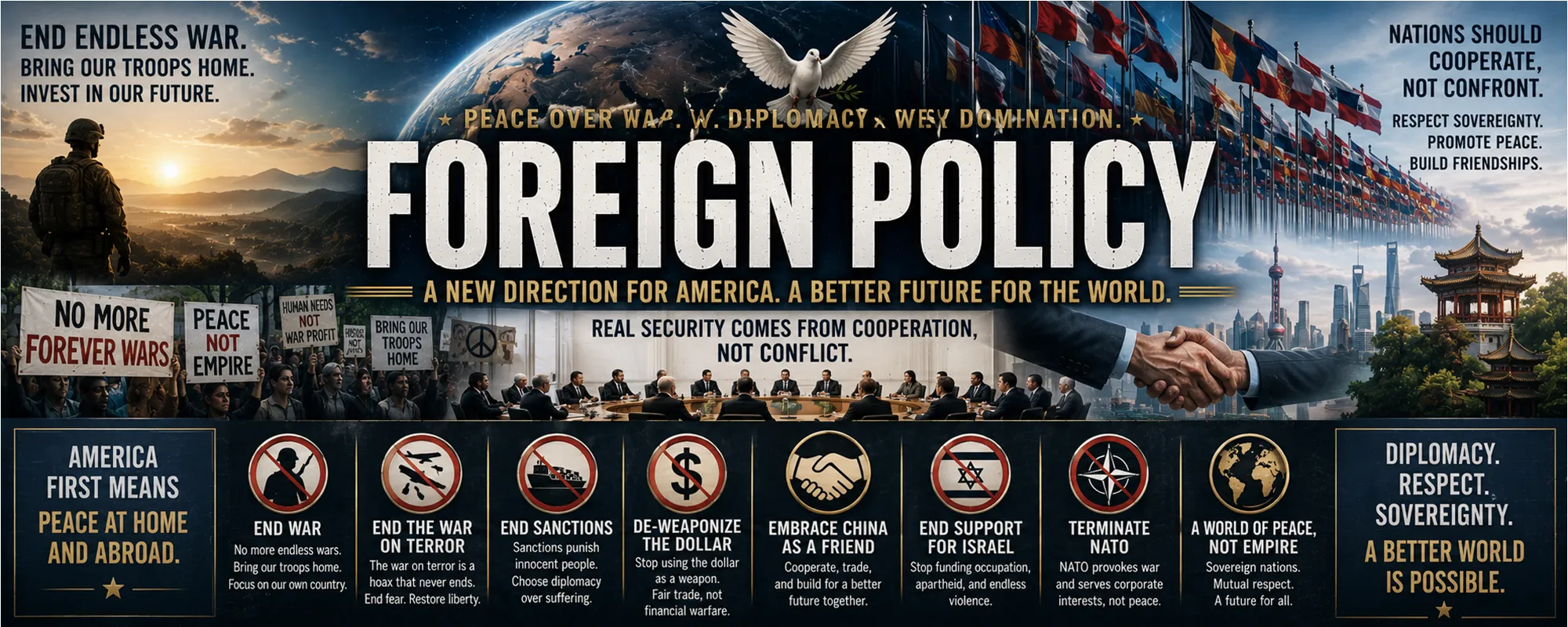
Foreign Policy
For decades, American foreign policy has been dominated by:
- endless wars,
- military intervention,
- regime change,
- sanctions,
- geopolitical confrontation,
- and global power projection.
Citizens are repeatedly told these policies promote:
- democracy,
- freedom,
- security,
- and stability.
Yet many interventions have instead produced:
- destruction,
- instability,
- civilian suffering,
- debt,
- corruption,
- refugee crises,
- and growing distrust throughout the world.
The Fifth Republic believes the United States must move away from permanent global conflict and toward a foreign policy rooted in:
- diplomacy,
- realism,
- restraint,
- cooperation,
- and peace.
Ending Endless War ↑
The United States has spent decades engaged in:
- military interventions,
- proxy wars,
- occupations,
- drone campaigns,
- and undeclared conflicts around the globe.
These wars have cost:
- enormous sums of money,
- countless lives,
- public trust,
- and long-term global stability.
Meanwhile, many of the same institutions and interests continue promoting new conflicts.
The Fifth Republic opposes endless war and supports a foreign policy that treats military force as a last resort rather than a permanent feature of international relations.
A healthy society cannot endlessly sacrifice:
- human lives,
- economic stability,
- civil liberties,
- and democratic accountability
to maintain perpetual geopolitical conflict.
Ending the Phony “War on Terror” ↑
The so-called “War on Terror” dramatically expanded:
- military intervention,
- surveillance,
- intelligence powers,
- secrecy,
- censorship,
- and executive authority.
After decades of conflict, many citizens question whether these policies actually produced:
- peace,
- stability,
- or genuine security.
The Fifth Republic believes fear should not become a permanent justification for:
- endless war,
- mass surveillance,
- erosion of civil liberties,
- or expansion of centralized power.
National security policies should remain:
- transparent,
- accountable,
- constitutionally limited,
- and subject to public scrutiny.
Ending Economic Warfare and Sanctions ↑
Economic sanctions are often presented as peaceful alternatives to war.
In practice, sanctions can devastate:
- economies,
- healthcare systems,
- food access,
- and civilian populations.
Political elites often remain insulated while ordinary citizens suffer.
The Fifth Republic opposes reckless economic warfare and believes diplomacy should take precedence over policies designed to:
- destabilize nations,
- punish populations,
- or maintain global dominance through financial coercion.
A stable world requires cooperation rather than permanent economic hostility.
De-Weaponizing the U.S. Dollar ↑
The U.S. dollar remains one of the most powerful financial instruments in the world.
American financial dominance allows governments and institutions to:
- restrict banking access,
- pressure foreign governments,
- impose sanctions,
- and shape international trade systems.
The Fifth Republic believes the dollar should not function as a weapon of global coercion.
Financial systems should support:
- trade,
- stability,
- economic development,
- and peaceful cooperation —
not permanent geopolitical pressure.
Weaponizing finance may strengthen short-term power while accelerating long-term instability and global fragmentation.
A Multipolar World ↑
The world is becoming increasingly multipolar.
Emerging powers such as:
- China,
- India,
- and other developing nations
are reshaping global economics and geopolitics.
The Fifth Republic believes the United States should adapt to this reality through:
- diplomacy,
- cooperation,
- economic engagement,
- and mutual respect.
The goal should not be global domination.
The goal should be peaceful coexistence within an interconnected world.
China Is Not America’s Enemy ↑
The Fifth Republic rejects the idea that the United States must treat China as a permanent enemy.
China is:
- a major civilization,
- economic power,
- technological competitor,
- and global partner.
Competition between nations does not require:
- hatred,
- militarization,
- propaganda,
- or inevitable war.
The Fifth Republic supports peaceful engagement, diplomacy, cultural exchange, and economic cooperation wherever possible.
Citizens of different nations should not be manipulated into fearing one another for the benefit of geopolitical power struggles.
NATO and Permanent Military Alliances ↑
The Fifth Republic believes Americans should openly debate the long-term role of military alliances such as NATO.
Critics argue that expanding military blocs and permanent geopolitical confrontation can:
- increase tensions,
- escalate conflicts,
- encourage militarization,
- and reduce opportunities for diplomacy.
The Fifth Republic supports reassessing international military commitments and reducing dependence on permanent confrontation-based foreign policy structures.
The goal should be collective peace and stability — not endless geopolitical escalation.
Ending Support for Foreign Aggression ↑
The Fifth Republic believes the United States should apply moral standards consistently rather than selectively.
Foreign governments — including allies — should not receive unconditional support regardless of:
- human rights abuses,
- civilian casualties,
- occupation policies,
- or violations of international law.
Citizens should remain free to:
- criticize foreign governments,
- debate foreign policy,
- and question military alliances
without fear of censorship or intimidation.
A principled foreign policy requires consistency rather than selective outrage.
Diplomacy Over Militarism ↑
Military power alone cannot create:
- trust,
- stability,
- legitimacy,
- or long-term peace.
The Fifth Republic supports:
- diplomacy,
- negotiation,
- trade,
- cultural exchange,
- and international cooperation
as preferable alternatives to militarism whenever possible.
A civilization obsessed with war eventually weakens itself economically, politically, and morally.
Seattle ↑
The Seattle Mayor doesn’t have the authority to dictate foreign policy, of course. However, it’s worth noting that Seattle’s supposedly enlightened liberals have some curiously right-wing views on foreign policy. Many Seattle liberals have an irrational hatred of China, for example. Most Seattle liberals will probably tell you they’re anti-war, but they may also tell you that they support the troops.
The Goal ↑
The Fifth Republic supports a foreign policy rooted in:
- peace,
- realism,
- diplomacy,
- sovereignty,
- and mutual respect between nations.
The United States should strive to become:
- a cooperative global partner,
- a constitutional republic,
- and a stable society focused on improving the lives of its own citizens rather than maintaining endless global conflict.
The goal is not isolationism.
The goal is a more peaceful and rational world order.
Videos ↑
Foreign Policy: Crash Course Government and Politics #50
The Heat: U.S. Foreign Policy
Prof. John Mearsheimer: 250 years of American Foreign Policy