
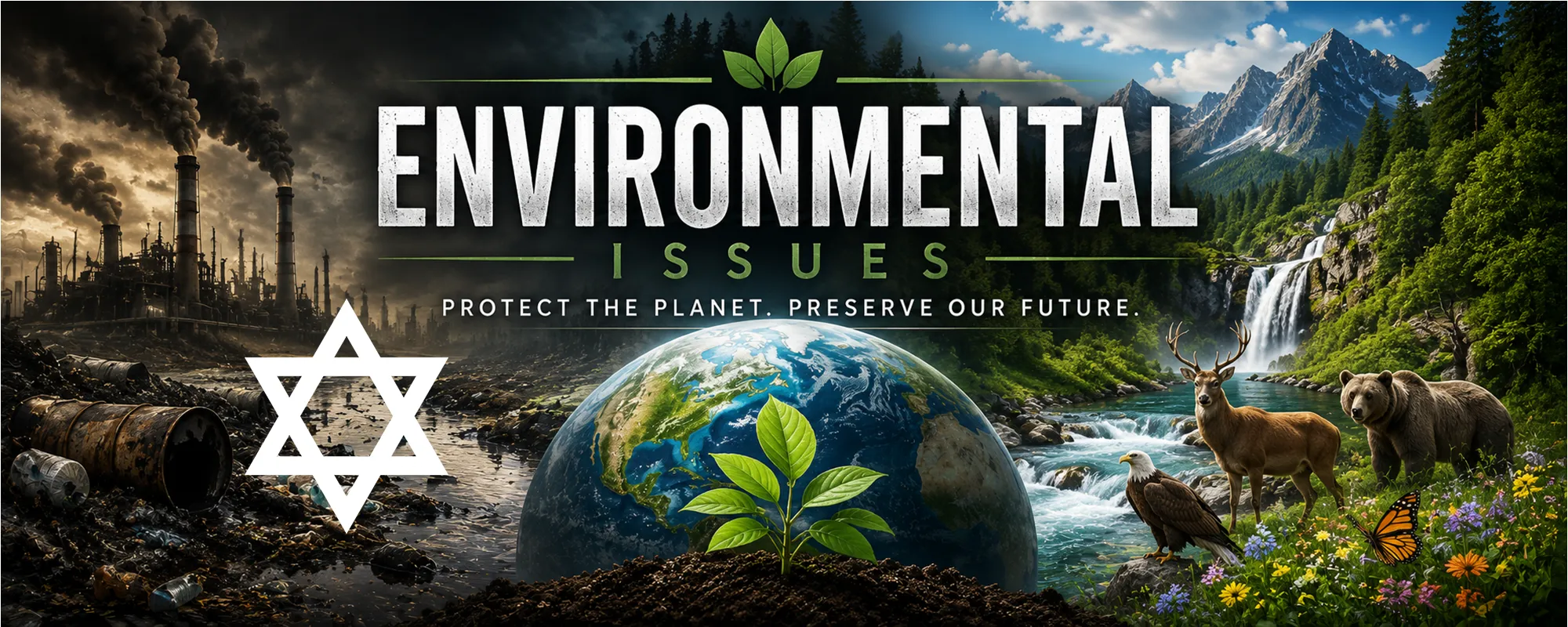
Environment
The environment is, or should be, the perennial #1 socio-political issue. Environmental issues affect:
- human health,
- agriculture,
- wildlife,
- national security,
- economic stability,
- and the future of civilization itself.
The Fifth Republic rejects the false choice between:
- corporate exploitation on one side,
- and ideological hysteria on the other.
Environmental policy should be based on:
- scientific inquiry,
- transparency,
- ecological sustainability,
- public accountability,
- and long-term thinking.
Nature is not merely a resource to exploit.
Human civilization depends on functioning ecosystems.
Climate Change ↑
Climate change is a serious issue that deserves honest scientific discussion rather than political tribalism.
The Fifth Republic supports:
- open scientific inquiry,
- environmental conservation,
- cleaner technologies,
- and long-term planning.
At the same time, citizens should be wary of:
- fear-based propaganda,
- corporate profiteering disguised as environmentalism,
- censorship of scientific debate,
- and policies that primarily benefit political or financial elites.
Environmental policy should not become an excuse for:
- authoritarian control,
- mass surveillance,
- economic exploitation,
- or the concentration of power.
Citizens deserve honest information rather than emotional manipulation.
The Loss of Biodiversity ↑
Human civilization is rapidly destroying:
- forests,
- wetlands,
- grasslands,
- coral reefs,
- rivers,
- and countless species.
Mass extinction is not science fiction.
The disappearance of:
- pollinators,
- fish populations,
- amphibians,
- birds,
- insects,
- and large predators
threatens ecological stability itself.
The Fifth Republic supports:
- habitat conservation,
- wildlife protection,
- sustainable land use,
- ecological restoration,
- and stronger protection for endangered ecosystems.
A healthy civilization cannot survive on a biologically dead planet.
Pollution ↑
Modern society pollutes:
- air,
- water,
- soil,
- food systems,
- and even the human body.
Industrial pollution has contributed to:
- cancer,
- neurological disorders,
- reproductive problems,
- contaminated waterways,
- and ecosystem collapse.
Meanwhile, corporations frequently externalize environmental costs while citizens pay the price.
The Fifth Republic supports:
- stronger environmental accountability,
- independent monitoring,
- cleanup of contaminated areas,
- and public transparency regarding industrial pollution.
No corporation should profit by poisoning communities.
Dams and Ecological Destruction ↑
Large dam systems have:
- displaced communities,
- disrupted fisheries,
- altered ecosystems,
- flooded natural habitats,
- and damaged river systems worldwide.
While hydroelectric power can provide benefits, environmental costs are often ignored or minimized.
The Fifth Republic supports:
- environmental impact transparency,
- restoration of damaged waterways where feasible,
- protection of fisheries,
- and balanced approaches to energy infrastructure.
Rivers are living systems — not merely industrial plumbing.
Genetically Modified Organisms (GMOs) ↑
Genetically modified organisms raise legitimate scientific, ecological, agricultural, and ethical questions.
The Fifth Republic supports:
- independent research,
- long-term safety testing,
- consumer transparency,
- and public access to information regarding genetically modified foods and crops.
Citizens should not be forced to blindly trust:
- biotech corporations,
- government agencies,
- or activist movements.
Scientific inquiry must remain open, independent, and transparent.
Agriculture should prioritize:
- ecological sustainability,
- biodiversity,
- soil health,
- food quality,
- and public well-being.
In addition, food products containing GMOs should be appropriately labeled. Such a policy would have been established by 2013 Washington Initiative 522, which appeared on the ballot on November 5, 2013. The measure would have required many genetically engineered (GMO) foods sold in Washington to carry labels.
Major opponents included:
- Monsanto
- DuPont
- Dow AgroSciences
- Bayer
- Grocery Manufacturers Association
- Coca-Cola
- PepsiCo
- Nestlé
- Washington State Farm Bureau
- Washington Association of Wheat Growers
The opposition campaign became one of the most expensive initiative fights in Washington history at the time.
The Grocery Manufacturers Association (later renamed the Consumer Brands Association) became especially controversial because Washington’s attorney general accused it of concealing donors and violating campaign-finance disclosure laws during the anti-I-522 campaign. Years later, the organization agreed to a major settlement and apology.
Supporters of I-522 argued consumers had a “right to know” what was in their food. Opponents argued the labeling requirements would increase costs, confuse consumers, and unfairly stigmatize GMO products.
The initiative ultimately failed, with roughly 51–55% voting against it, depending on the stage of vote counting referenced.
The Destruction of Soils ↑
Healthy soil is one of civilization’s most important resources.
Modern industrial agriculture has contributed to:
- erosion,
- nutrient depletion,
- chemical contamination,
- desertification,
- and declining soil fertility.
Without healthy soils:
- food systems weaken,
- ecosystems collapse,
- and societies become increasingly unstable.
The Fifth Republic supports:
- regenerative agriculture,
- sustainable farming practices,
- soil conservation,
- reduced chemical dependency,
- and protection of farmland from reckless development.
Civilizations rise and fall partly on the condition of their soil.
Environmentalism Without Hypocrisy ↑
Environmental concern should not become:
- corporate branding,
- elite virtue signaling,
- or political theater.
Many institutions that publicly promote sustainability simultaneously support:
- endless war,
- mass consumption,
- destructive industrial practices,
- planned obsolescence,
- and global systems built on exploitation.
Real environmentalism requires confronting:
- corruption,
- corporate power,
- unsustainable economic systems,
- and reckless consumption patterns.
Humanity and Nature ↑
The Fifth Republic rejects the idea that humanity must choose between:
- technological progress,
- and environmental stewardship.
Human beings are part of nature, not separate from it.
A healthy civilization should seek:
- cleaner technologies,
- sustainable infrastructure,
- conservation,
- scientific innovation,
- and ecological responsibility.
The goal is not primitivism.
The goal is balance.
Seattle ↑
Seattle and Washington State have a mixed environmental reputation Some of the major environmental records and themes associated with Seattle and Washington include:
Positive Environmental Reputation ↑
- Extensive hydroelectric power usage (Washington has one of the cleanest electricity grids in the U.S.)
- Large protected forests and wilderness areas
- Strong recycling and conservation culture
- Aggressive climate and carbon-reduction policies
- Early adoption of green building standards
- Major investment in public transit and urban density
- Important salmon restoration and habitat programs
Washington is often ranked among the “greenest” states in America in terms of electricity production and outdoor conservation.
Major Environmental Problems and Criticisms ↑
Puget Sound Pollution ↑
Puget Sound faces:
- stormwater runoff,
- industrial pollution,
- sewage overflow,
- toxic sediment,
- declining salmon populations.
Despite decades of cleanup programs, many scientists say recovery has been slower than hoped. Reports that the City of Seattle was dumping raw sewage in the Sound raised eyebrows. I’m not sure if the practice continues.
Boeing & Industrial Contamination ↑
Boeing has historically been linked to:
- groundwater contamination,
- solvent pollution,
- toxic waste sites,
- PFAS and chemical concerns,
- industrial emissions.
The Lower Duwamish Waterway became a major Superfund site partly because of decades of industrial dumping from multiple companies.
Bill Gates ↑
If you thought crappy software is Bill Gates’ only problem, guess again.
In fact, Bill Gates could be a bigger threat to the global individual than any other individual on the planet. Gates’ involvement with the genetically modified food (GMO) industry is cause for alarm, especially when combined with his reputation for buying up prime farmland across the U.S.
Gates’ legendary experiments with mosquitoes have also raised environmentalists’ eyebrows. In comparison, the enormous carbon footprint associated with Gates’ stable of homes and yachts seems minor.
Duwamish River Superfund Site ↑
Duwamish River is one of the most notorious environmental issues in Seattle:
- contaminated sediment,
- heavy metals,
- PCBs,
- cancer concerns,
- disproportionate impacts on poorer communities and tribes.
Hanford Nuclear Site ↑
Hanford is generally regarded as the most contaminated nuclear weapons production site in the United States and one of the most contaminated nuclear sites in the world. Cleanup has cost well over $100 billion and may continue for generations.
Homelessness & Urban Waste ↑
Seattle has also faced criticism over:
- trash accumulation,
- needles,
- human waste,
- park degradation,
- RV dumping,
- water contamination tied to encampments.
This became politically controversial because Seattle simultaneously promotes a strong environmental image.
Logging Controversies ↑
Washington has long-standing battles over:
- old-growth logging,
- spotted owl habitat,
- tribal rights,
- forestry economics,
- wildfire management.
Environmentalists and logging communities have clashed for decades.
Salmon Decline ↑
Salmon are culturally and environmentally central in Washington, yet many runs remain threatened because of:
- dams,
- warming waters,
- habitat destruction,
- overdevelopment,
- pollution.
This is one of the state’s defining environmental concerns.
Areas Where Washington Often Scores Well ↑
Compared to many states, Washington generally performs relatively well in:
- renewable energy,
- air quality,
- conservation land,
- public transit usage,
- environmental activism,
- urban tree coverage.
Seattle especially has a strong environmental political culture.
Areas Critics Say Are Overlooked ↑
Critics sometimes argue that Seattle/Washington environmental branding obscures:
- corporate influence,
- tech industry growth impacts,
- housing-driven sprawl,
- shipping pollution,
- aviation emissions,
- industrial cleanup delays,
- environmental inequality in poorer neighborhoods.
Those debates can become very political, especially in Seattle.
The Goal ↑
The Fifth Republic seeks an environmental philosophy rooted in:
- sustainability,
- scientific honesty,
- ecological responsibility,
- public accountability,
- and long-term survival.
Future generations deserve:
- clean water,
- healthy soil,
- functioning ecosystems,
- thriving wildlife,
- and a livable world.
Environmental protection is not merely about saving nature.
It is about preserving civilization itself.
Videos ↑
Extinction Event
When Will Extreme Heat Become Unlivable?
Something Strange Is Happening Under the Doomsday Glacier