
Surveillance
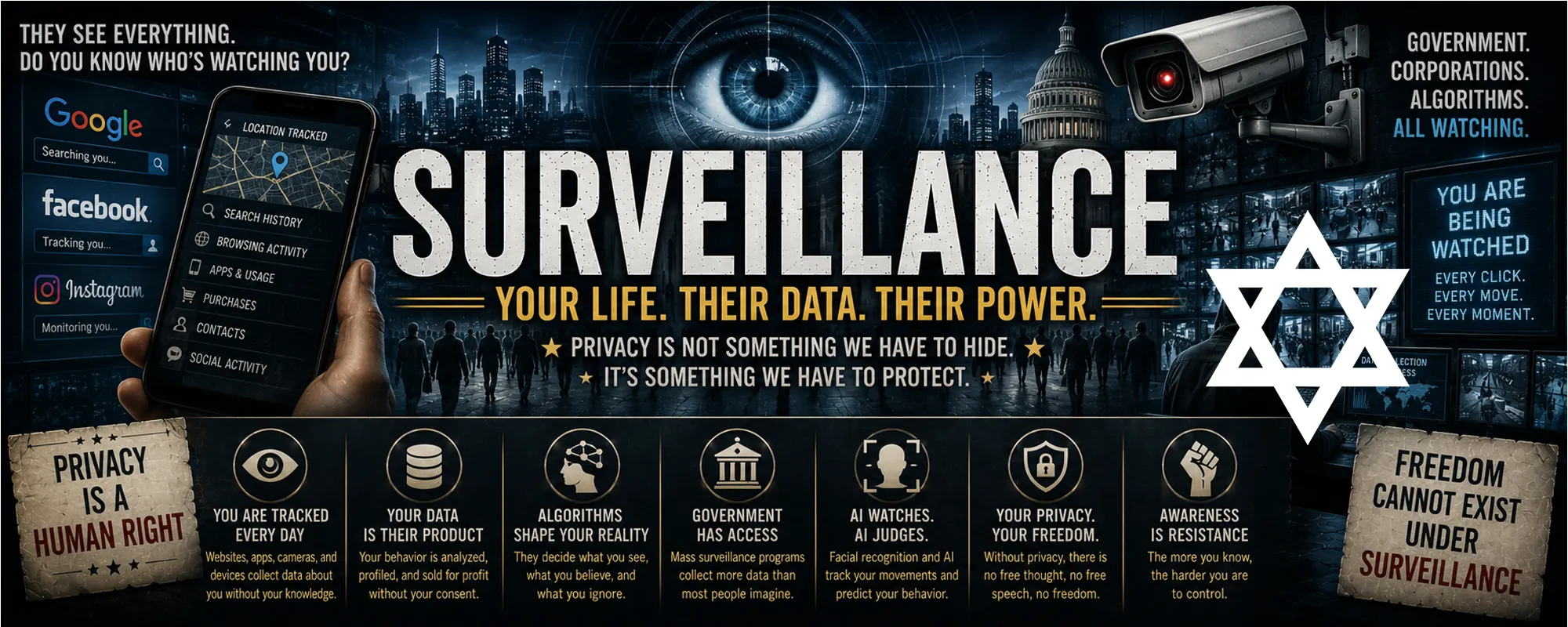
Modern citizens are increasingly monitored in ways previous generations could scarcely imagine.
Through:
- smartphones,
- websites,
- social media,
- cameras,
- financial systems,
- artificial intelligence,
- and digital tracking technologies,
governments and corporations now possess unprecedented abilities to: - monitor behavior,
- analyze habits,
- predict actions,
- influence opinions,
- and shape human behavior.
The Fifth Republic believes privacy is essential to:
- liberty,
- creativity,
- psychological health,
- and democratic society itself.
A society where citizens are constantly watched cannot remain truly free.
You Are Being Tracked ↑
Most citizens are tracked daily through:
- search engines,
- websites,
- apps,
- smartphones,
- online purchases,
- GPS systems,
- and social media platforms.
Major technology companies collect enormous amounts of information regarding:
- browsing history,
- location,
- purchases,
- relationships,
- interests,
- political preferences,
- habits,
- and psychological behavior.
Many citizens unknowingly surrender personal information simply by participating in modern digital life.
The Fifth Republic believes citizens deserve:
- transparency,
- informed consent,
- meaningful privacy protections,
- and greater control over personal data.
Human beings should not become products to be monitored, analyzed, and sold.
Google, Facebook, and the Data Economy ↑
Modern technology companies increasingly profit from surveillance itself.
Platforms such as:
- search engines,
- social networks,
- advertising systems,
- and mobile ecosystems
often rely on massive data collection to: - target advertising,
- shape user behavior,
- maximize engagement,
- and influence attention.
Citizens are not merely using these platforms.
In many ways, they themselves become the product.
The Fifth Republic believes citizens should better understand how:
- personal data,
- behavioral profiles,
- emotional patterns,
- and online activity
are monetized within modern digital economies.
Privacy should not disappear simply because technology companies find surveillance profitable.
Surveillance and Psychological Manipulation ↑
Modern surveillance systems do more than collect information.
They increasingly attempt to:
- shape behavior,
- influence emotion,
- predict decisions,
- and manipulate public opinion.
Algorithms can determine:
- what people see,
- what information spreads,
- what narratives dominate,
- and which viewpoints are suppressed.
Combined with:
- AI systems,
- social media,
- targeted advertising,
- and behavioral analytics,
modern surveillance increasingly overlaps with psychological influence and social engineering.
The Fifth Republic believes citizens should remain aware of how technology shapes:
- attention,
- beliefs,
- emotions,
- and public discourse.
Government Surveillance ↑
Governments historically expand surveillance powers during:
- wars,
- crises,
- emergencies,
- and periods of fear.
Temporary surveillance measures often become permanent systems.
Citizens increasingly face:
- mass data collection,
- digital monitoring,
- facial recognition,
- intelligence sharing,
- and reduced privacy protections.
The Fifth Republic supports:
- stronger warrant protections,
- intelligence oversight,
- transparency,
- and meaningful limits on domestic surveillance powers.
National security should not become a permanent justification for monitoring entire populations.
Facial Recognition and AI Monitoring ↑
Artificial intelligence dramatically expands surveillance capabilities.
Modern systems can already:
- identify faces,
- track movement,
- analyze emotions,
- recognize voices,
- and predict behavioral patterns.
Combined with:
- cameras,
- smartphones,
- financial records,
- and online activity,
AI could enable extraordinarily intrusive monitoring systems.
The Fifth Republic opposes the development of societies where citizens are:
- continuously tracked,
- behaviorally scored,
- or monitored through automated systems.
Human freedom requires spaces where citizens are not constantly observed and analyzed.
Surveillance and Free Speech ↑
Citizens who believe they are constantly monitored may gradually:
- self-censor,
- avoid dissent,
- fear controversy,
- and conform socially.
Surveillance affects not only privacy, but also:
- speech,
- thought,
- creativity,
- political participation,
- and psychological freedom.
A society where citizens fear speaking openly cannot remain democratic for long.
The Fifth Republic believes civil liberties and privacy are deeply interconnected.
Freedom requires the ability to think, speak, and associate without constant monitoring.
Corporate and Government Collaboration ↑
Modern surveillance systems increasingly blur the line between:
- corporate monitoring,
- government intelligence,
- and political influence.
Technology companies often possess more detailed information about citizens than governments historically ever could.
The Fifth Republic supports:
- transparency regarding data-sharing practices,
- limits on corporate-government surveillance partnerships,
- and stronger protections for citizen privacy.
Neither governments nor corporations should possess unlimited power to monitor society.
Surveillance and Human Dignity ↑
Human beings require:
- privacy,
- solitude,
- intellectual freedom,
- and personal autonomy.
A civilization where every:
- movement,
- communication,
- purchase,
- relationship,
- and opinion
is monitored risks creating populations defined by: - fear,
- conformity,
- dependency,
- and psychological insecurity.
The Fifth Republic believes human dignity requires freedom from constant observation and behavioral manipulation.
Citizens should remain human beings — not permanently monitored data profiles.
Seattle ↑
Its status as headquarters for Microsoft alone guarantees surveillance is a potent issue in Seattle. Of course, any Seattleite with a computer must also deal with online spies like Google and Facebook.
The Goal ↑
The Fifth Republic supports a future where:
- technology remains accountable,
- privacy is protected,
- surveillance powers are limited,
- and citizens retain control over their personal lives.
Modern societies must balance:
- innovation,
- security,
- liberty,
- and human dignity.
The goal is not isolation from technology.
The goal is preserving freedom within an increasingly technological world.
Videos ↑
What happens at Homeland Security?
Here's Why the Patriot Act Is So Controversial
https://www.youtube.com/watch?v=LPRdae-xdfs
Has The U.S. Become A Surveillance State? | Incognito Mode