
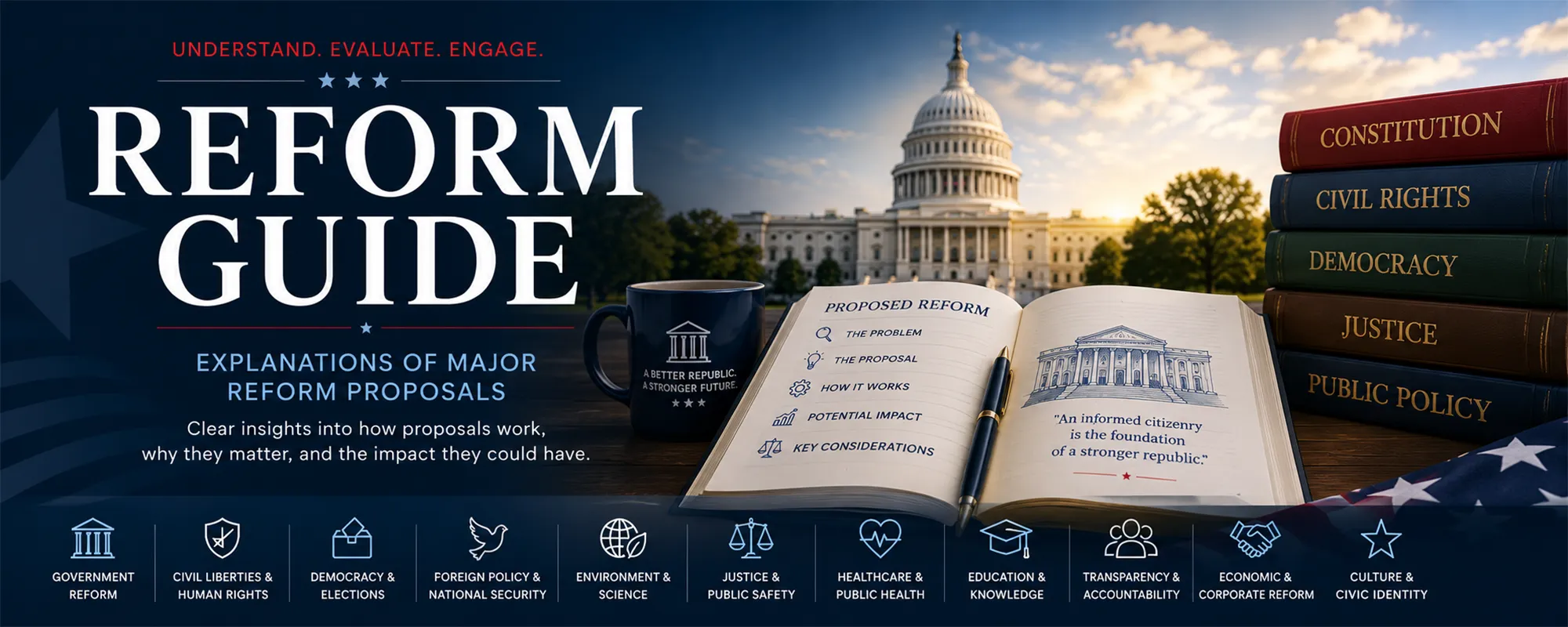
Reform Guide
Explanations of Major Reform Proposals
This page offers some background and supplemental information related to Fifth Republic’s Reform Agenda. This project was undertaken in some haste, and it will take a while to work out all the kinks.
As time allows, I hope to divide this into several pages with more details.
I. Democracy & Election Reform ↑
Democracy reform proposals seek to change how candidates are nominated, how votes are cast, how representatives are elected, and how citizens participate in government. Supporters argue that electoral systems shape political behavior and can affect representation, competition, and public confidence.
I. a) Voting Systems ↑
Voting-system reforms seek to change how ballots are cast and counted.
Examples include:
- ranked-choice voting
- open primaries
- digital voting systems
- alternative voting systems
Supporters argue these systems may:
- reduce strategic voting
- increase voter choice
- encourage broader participation
Critics sometimes raise concerns involving:
- complexity
- security
- implementation costs
Open-primary proposals would allow voters to participate in primary elections without formally registering with a political party. Supporters argue such systems can increase participation and encourage candidates to appeal to a broader range of voters.
I. b) Representation and Electoral Structure ↑
Representation reforms attempt to determine how votes translate into political power.
Examples include:
- proportional representation
- multi-member districts
- Electoral College reform
- national popular vote proposals
Supporters argue such reforms may:
- increase representation for minority viewpoints
- reduce winner-take-all outcomes
- reduce geographic distortions
Electoral College proposals range from modest reforms to complete abolition. Supporters of a national popular vote argue that every vote should carry equal weight regardless of state boundaries, while supporters of the current system argue it protects the interests of smaller states and preserves the federal nature of the republic.
I. c) Campaign Finance Reform ↑
Public-financing proposals seek to reduce dependence on private donors.
Examples include:
- public grants
- matching funds
- campaign vouchers
Supporters argue these systems may:
- increase competition
- reduce perceived corruption
- allow candidates with fewer resources to compete
I support public-financing systems that reduce reliance on large donors and provide candidates with alternative sources of campaign funding.
I. d) Direct Democracy ↑
Direct-democracy systems allow citizens to participate more directly in policymaking.
Examples include:
- initiatives
- referendums
- recalls
- citizen assemblies
Supporters argue these mechanisms may increase public participation and reduce dependence on elected intermediaries.
I also support reasonable waiting periods before substantially identical ballot measures may be resubmitted after voter rejection. Such provisions may help prevent repeated elections on the same question until a desired outcome is achieved.
I e) Congressional Term Limits ↑
Term-limit proposals seek to limit the number of years elected officials may serve.
Supporters argue term limits may:
- reduce career politics
- encourage new leadership
- reduce entrenched power structures
Critics argue they may reduce institutional experience and increase reliance on staff, lobbyists, or unelected actors.
II. Civil Liberties ↑
Civil-liberties proposals seek to protect individual rights against government, corporate, and institutional power. Supporters argue that constitutional freedoms must evolve alongside technological, social, and political changes.
II. a) Repeal or Reform the Patriot Act ↑
The Patriot Act expanded government surveillance and investigative powers after the September 11 attacks.
Supporters of repeal argue:
- surveillance powers became too broad
- privacy protections weakened
- secret government monitoring expanded
Opponents of repeal argue such powers remain necessary for national security.
II. b) FISA Reform ↑
The Foreign Intelligence Surveillance Act (FISA) established special procedures for intelligence gathering involving national-security investigations.
Critics argue:
- secret court proceedings limit accountability
- surveillance authorities have expanded beyond their original purpose
- civil-liberties protections may be weakened
Supporters argue intelligence agencies require specialized tools to identify and disrupt foreign threats.
I support substantial reforms designed to increase transparency, strengthen due-process protections, and limit unnecessary surveillance of Americans.
II. c) Digital Bill of Rights ↑
A Digital Bill of Rights would attempt to define legal protections for individuals online.
Proposals often include:
- control over personal data
- privacy protections
- limits on surveillance
- algorithm transparency
- digital ownership rights
Supporters argue that constitutional rights should evolve with technology.
II. d) Privacy Amendment ↑
A Privacy Amendment would explicitly recognize privacy rights in modern contexts.
Potential protections:
- online privacy
- biometric data
- location data
- digital communications
Supporters argue current constitutional protections predate the Internet age and should be expanded to protect privacy in digital communications and online activity.
II. e) Right to Repair ↑
Right-to-Repair proposals would require manufacturers to allow consumers to repair products they own.
Supporters argue:
- ownership should include repair rights
- repair restrictions increase costs
- fewer restrictions reduce waste
II. f) Restore Net Neutrality ↑
Net neutrality generally requires internet providers to treat internet traffic equally.
Supporters argue:
- prevents preferential treatment
- protects smaller voices
- preserves competition
Opponents argue regulation can discourage infrastructure investment.
II. g) Equal Rights Amendment ↑
The Equal Rights Amendment would prohibit discrimination based on sex at the constitutional level.
Supporters argue:
- constitutional protections are stronger than ordinary statutes
- legal standards become clearer
- equal treatment should be explicitly guaranteed by the Constitution
II. h) Internet Free Speech Amendment ↑
Would extend or clarify constitutional protections involving digital communication.
Supporters argue:
- modern political speech increasingly occurs online
- legal standards are evolving
- constitutional protections should apply regardless of communication medium
I support a constitutional amendment explicitly protecting freedom of expression in digital communications and online activity.
II. i) Section 230 Reform ↑
Section 230 of the Communications Decency Act provides liability protections for online platforms regarding content posted by users.
Supporters argue these protections encourage innovation and permit online discussion forums to operate without excessive legal risk.
Critics argue Section 230 grants large technology companies extraordinary power over public discourse while shielding them from accountability.
I support repeal or substantial reform of Section 230 to improve transparency, accountability, and consistency in online content moderation.
II. j) Rantisemitism Reform ↑
The manipulation and exploitation of the nonsensical term antisemitism is bad enough. Unfortunately, the term has become increasingly weaponized, posing a serious threat to Americans’ civil liberties and to people’s freedoms around the world.
I propose a law that establishes an official terminology to be followed in the political and legal arenas.
In plain English, no one should be legally prosecuted, disciplined, or punished for “antisemitism.” Instead, they should be prosecuted for anti-Jewism or, better yet, plain old-fashioned bigotry or hate speech.
We also need laws to protect us from Jews and their stooges who conflate anti-Jewism with various things that do not necessarily indicate a hatred of the entire Jewish community.
A classic example is Zionism. Yes, the vast majority of Jews are likely Zionists, but there are exceptions. In addition, many non-Jews are Zionists as well, including pResident Donald Trump and virtually his entire administration. Anti-Zionism is not the same as anti-Jewism, not does a hatred of Israel necessarily translate into a hatred of all Jews.
Third, we need a law or provision focusing on double standards. I was censured for using the term “Jew flu” during the pandemic, but where was the outrage over the use of the term “China flu” by Donald Trump and the Jew-controlled media?
Fourth, people should not be censured or prosecuted for their beliefs about Jews. There may be no better example than the Holocaust.
Some people believe the Holocaust never happened; it is simply the product of Jewish propaganda. Other people believe it did happen, but they aren’t in complete agreement with the mainstream narrative. For example, they may not believe the Germans killed six million Jews or that Hitler was plotting a genocide from the very beginning. Some people believe the Jews brought the Holocaust on themselves. Some people embraxe Adolf Hitler as a hero, a belief a war correspondent named John F. Kennedy seemed to share.
None of these beliefs are less rational than the preposterous tale the Jews have spun. Even if they were not rational, they should not be illegal. Some historians believe Abraham Lincoln was Jewish, while others believe he was gay. Believing he was a Jew is perfectly legal.
It is always OK to question historical events (or false historical claims). Enshrining the mainstream Holocaust narrative in law doesn’t make it true.
Condemning people for such beliefs is wrong, unless we also want to condemn people who hate communism and communists, North Koreans, the Mongols, colonialism, and similar groups and beliefs.
In a similar vein, the use of terms like “antisemitic trope” is dishonest and at odds with education and rational thinking. How can we tell young people that Israel doesn’t control the United States government when two pResidents representing both the Democratic and Republican partices gave Israel enormous amounts of aid and support even as it was perpetrating the Gaza Genocide? How can we call the claim that Jews control the media an antisemitic trope when they obviously do?
Finally, we should not pressure people to hate the same things Jews do. The Christian cross has been drenched in blood for two thousands year, so why is it OK to display a Christian cross but not a swastika? Why should everyone around the world be expected to hate Adolf Hitler and members of his National Socialist Party? Hitler did not own slaves (e.g. George Washington), and he wasn’t a pedophile (e.g. Donald Trump).
There’s a lot to digest here, and it will take time to whip it into a legislative proposal(s). I have more to say about it here.
II. k) Repeal Civil Asset Forfeiture ↑
Civil asset forfeiture allows governments to seize property associated with alleged criminal activity.
Critics argue:
- property can sometimes be seized without criminal conviction
- incentives may become distorted
Supporters of reform argue property rights and due-process protections should be strengthened before governments are permitted to permanently seize private property.
II. l) Immigration Reform ↑
Immigration and border proposals vary greatly.
Potential reforms include:
- changing detention rules
- altering asylum procedures
- modifying enforcement policies
- revising border-security measures
- reforming deportation procedures
I support reform of immigration and border policies that fail to protect civil liberties, provide due process, or treat individuals fairly under the law.
III. Anti-Corruption ↑
Anti-corruption proposals seek to reduce undue influence, increase transparency, and strengthen public confidence in institutions. Supporters argue that concentrated wealth, lobbying power, opaque decision-making, and weak oversight can distort democratic systems.
III. a) Abolish Corporate Personhood ↑
Supporters of this proposal argue corporations should not possess constitutional protections similar to those of natural persons. Advocates often argue that constitutional rights should belong primarily to human beings rather than legal entities.
Many supporters of corporate-personhood reform also advocate limits on corporate political spending and election influence. They argue that large corporations should not be permitted to exercise political power disproportionate to that of individual citizens.
III. b) Limit Excessive Corporate Concentration ↑
These proposals attempt to reduce situations where a small number of corporations dominate markets, exercise excessive economic power, or exert disproportionate influence over public policy and political institutions.
Supporters argue:
- competition increases
- innovation improves
- political influence decreases
III. c) Restrict Lobbying and Ban Lobbyist Influence ↑
Lobbying reform proposals range from tighter disclosure requirements to broad restrictions on lobbying activities.
Supporters argue:
- large organizations possess disproportionate influence
- public officials may become dependent on major donors and lobbyists
III. d) Congressional Financial Restrictions ↑
These proposals seek to reduce conflicts of interest involving elected officials. Examples include congressional stock-trading bans, enhanced financial-disclosure requirements, blind trusts, and other restrictions designed to prevent public office from being used for private financial gain.
Examples:
- stock trading restrictions
- financial disclosure requirements
- blind trusts
III. e) Restrict Highly Leveraged Acquisitions ↑
Supporters argue some leveraged buyouts burden acquired companies with debt and may contribute to layoffs, bankruptcies, or short-term profit extraction.
III. f) Independent Anti-Corruption Agency ↑
Supporters argue specialized agencies can investigate misconduct independently of ordinary political pressures.
Potential responsibilities:
- investigate corruption
- review ethics complaints
- examine financial disclosures
III. g) Public Lobbying Database ↑
Supporters propose searchable public systems listing:
- lobbyists
- clients
- expenditures
- meetings
- policy targets
Supporters also advocate mandatory disclosure of meetings between lobbyists and public officials so citizens can better understand who is attempting to influence government decisions.
III. h) Lifetime Lobbying Restrictions ↑
Supporters seek limits on the “revolving door” between government service and lobbying careers.
III. i) Financial Transparency Requirements ↑
Examples:
- asset disclosure
- income reporting
- conflict-of-interest reporting
III. j) Citizen Audit Boards ↑
Citizen oversight boards would review government activities, expenditures, and investigations.
Supporters argue this increases public participation.
III. k) Independent Ethics Commissions ↑
Ethics commissions would investigate misconduct and enforce standards for public officials.
III. l) Break Up Big Tech ↑
Some advocates argue certain technology companies have accumulated excessive economic and informational power.
Targets frequently discussed include:
- Microsoft
- Apple
- Meta
- Amazon
III. m) Publicly Funded Media Alternatives ↑
Supporters propose public-interest media organizations that operate independently of corporate ownership and major private donors.
Proposals range from exploring publicly funded media alternatives to creating permanent public-interest media funding mechanisms designed to support investigative journalism, educational programming, and independent reporting.
III. n) Algorithm Transparency Rules ↑
Supporters seek disclosure regarding how algorithms influence:
- recommendations
- news feeds
- search results
- content moderation
III. o) Government Transparency Portals ↑
Supporters seek centralized public websites where government activities become easily searchable.
III. p) Open-Data Requirements ↑
Supporters seek machine-readable public information that researchers and citizens can analyze.
III. q) Whistleblower Protections ↑
Supporters argue employees should receive stronger protection when reporting:
- corruption
- fraud
- abuse
- waste
III. r) Supreme Court Reform ↑
Examples include:
- term limits
- ethics rules
- recusal standards
- financial disclosure requirements
III. s) Audit the Federal Reserve ↑
Supporters argue broader audits would increase transparency regarding monetary policy and emergency programs.
III. t) Department of Peace ↑
Supporters envision a cabinet-level department emphasizing diplomacy, conflict prevention, and peaceful dispute resolution.
III. u) Judicial Ethics Reform ↑
Examples include:
- restrictions on gifts
- mandatory recusal rules
- financial disclosure requirements
- enforceable ethics standards
Supporters argue stronger rules increase public confidence in judicial impartiality.
III. v) International Finance & Sovereign Protection ↑
These proposals address conflicts between private financial interests and the economic sovereignty of nations.
Supporters argue that private investors, hedge funds, and other financial actors should not be permitted to undermine the economic stability of sovereign nations through predatory litigation, asset seizures, or other practices that interfere with legitimate governmental functions.
Examples include:
- restrictions on actions that intentionally destabilize foreign economies
- protections for sovereign immunity
- limitations on certain asset-seizure practices
- reforms of sovereign-debt litigation procedures
Supporters argue that sovereign governments should be protected from abusive financial tactics while preserving legitimate mechanisms for resolving international financial disputes.III. )
III. w) Corporate Transparency & Financial Accountability ↑
These proposals seek to increase transparency regarding corporate ownership, offshore financial arrangements, and international tax practices.
Supporters argue that complex offshore structures can conceal ownership, obscure financial activity, reduce accountability, and make it difficult for governments and citizens to understand who ultimately controls major corporations and assets.
Examples include:
- greater transparency regarding offshore corporate structures
- restrictions on tax-haven abuse and offshore profit shifting
- beneficial-ownership disclosure requirements
Supporters argue that greater transparency improves accountability, reduces opportunities for corruption, and helps ensure that corporations compete under fair and consistent rules.
IV. Government Structure Reform ↑
Government structure reforms focus less on specific policy disputes and more on how government itself operates. Supporters argue that many modern problems result not merely from bad decisions, but from institutional structures that encourage inefficiency, concentration of power, and weak accountability.
IV. a) Executive Branch Reform ↑
Executive-branch reforms seek to define the powers, limitations, structure, and accountability of the presidency and executive agencies.
Examples include:
- restricting executive orders
- narrowing emergency powers
- strengthening congressional oversight of executive agencies
- restructuring Cabinet departments
- creating new executive departments
- reforming or abolishing presidential pardon powers
IV. b) Congressional Reform ↑
Congressional reform proposals seek to improve accountability, transparency, efficiency, and public confidence in the legislative branch.
Examples include:
- congressional term limits
- longer House terms
- restrictions on omnibus legislation
- single-subject legislation requirements
- mandatory public review periods before major votes
- earmark reform
- compensation systems tied to measurable performance benchmarks
Supporters argue these reforms could reduce legislative dysfunction, improve transparency, and make elected officials more accountable to voters.
IV. c) Supreme Court Reform ↑
The Supreme Court has increasingly become the subject of structural reform proposals.
Common proposals include:
- fixed terms instead of lifetime appointments
- ethics rules
- mandatory recusal standards
- modifying the number of justices
Supporters argue such measures could increase public confidence and reduce politicization.
IV. d) Federal Structure Reform ↑
Federal-structure reforms address the division of authority between the national government and the states.
Examples include:
- expanding state autonomy
- clarifying federal powers
- reforming interstate compacts
- examining secession movements and related constitutional questions
Supporters argue that clearer divisions of authority can reduce conflict, improve accountability, and better accommodate regional differences. Debates in this area often focus on balancing national unity with local self-government.
IV. e) Constitutional Process Reform ↑
Constitutional-process reforms address how societies amend, review, interpret, and potentially replace their governing charters.
Examples include:
- constitutional convention procedures
- Article V convention rules
- periodic constitutional review
- constitutional rewrite or "Second Republic" proposals
Supporters argue that constitutional systems should include clear and transparent mechanisms for peaceful reform. Some advocate periodic review of constitutional structures, while others support more comprehensive reforms that could result in substantial revisions or the creation of an entirely new constitutional framework.
IV. f) War Powers & Military Authorization ↑
War-powers reforms seek to clarify the constitutional division of authority between Congress and the President regarding military action.
Examples include:
- repealing broad executive war powers
- clarifying statutory war-authority provisions
- constitutional amendments governing military authorization
Supporters argue that decisions involving war and military action should receive greater congressional scrutiny and approval. Critics argue that presidents require sufficient flexibility to respond rapidly to emergencies and national-security threats.
IV. g) Budget & Fiscal Structure Reform ↑
Budget and fiscal reforms seek to improve long-term financial sustainability and strengthen fiscal accountability.
Examples include:
- balanced-budget requirements
- balanced-budget amendments
- fiscal oversight procedures
- long-term debt management reforms
Supporters argue that governments should generally match spending and revenue except during defined emergencies such as wars, recessions, or natural disasters. Critics argue that strict balanced-budget requirements can limit flexibility during economic downturns.
IV. h) Government Modernization ↑
Government-modernization proposals seek to improve the efficiency, transparency, accessibility, and long-term effectiveness of public institutions.
Examples include:
- government modernization initiatives
- sunset clauses for laws and regulations
- public digital identity systems
Supporters argue governments should periodically review outdated programs, adopt modern technology where appropriate, and improve public access to government services and information.
V. Foreign Policy and National Security Reform ↑
Foreign-policy and national-security proposals attempt to define the role of the United States in global affairs. Supporters of reform often disagree sharply on goals, but many proposals revolve around military intervention, alliances, diplomacy, sovereignty, and the use of economic influence.
V. a) Diplomacy and Recognition: Israel ↑
Diplomatic recognition determines which governments the United States formally recognizes and engages with.
Proposals in this area may include:
- recognizing or withdrawing recognition of governments
- changing diplomatic relationships
- imposing sanctions
- modifying foreign aid
Supporters argue such actions can influence foreign behavior and align policy with national values or strategic goals.
V. b) Foreign Aid & Economic Relations ↑
Foreign-aid and economic-relations proposals address how the United States uses financial assistance, trade, investment, and commercial relationships to advance foreign-policy objectives.
Examples include:
- foreign-aid restrictions
- trade restrictions
- investment restrictions
- commercial sanctions
Supporters argue that American tax dollars and commercial activity should be consistent with broader foreign-policy goals and national interests.
V. c) Military Footprint and Overseas Bases ↑
The United States maintains numerous military installations outside its territory.
Supporters of reductions often argue:
- overseas commitments are expensive
- military presence can increase tensions
- resources could be redirected domestically
Opponents argue overseas bases:
- support alliances
- deter conflict
- improve rapid response capability
V. d) Alliances and International Organizations ↑
International alliances such as NATO involve collective defense arrangements.
Supporters argue alliances strengthen security and deterrence.
Critics sometimes argue alliances:
- increase foreign obligations
- reduce flexibility
- involve the United States in distant conflicts
Moreover, NATO is an instrument of Western power, a key component of the so-called Anglo-Zionist empire. NATO invaded and destroyed Libya, in the process murdering Muammar Gadaffi, Africa’s brightest star. NATO also pushed Russia into invading Ukraine. NATO needs to be terminated.
V. e) Nuclear Policy ↑
Nuclear disarmament proposals seek reductions or elimination of nuclear weapons.
Supporters argue:
- nuclear war risks are catastrophic
- disarmament reduces global danger
Critics argue:
- nuclear deterrence may prevent major wars
V. f) Military Authorization ↑
The 2001 AUMF gave presidents broad authority to use military force against organizations connected to the September 11 attacks.
Critics argue:
- its language has been applied far beyond its original purpose
- military authority became too broad
Supporters argue it provides flexibility against evolving threats.
VI. Economic & Corporate Reform ↑
Economic reform proposals seek to address wealth distribution, corporate power, market structure, wages, taxation, and access to financial systems. Supporters argue that economic systems should promote broad prosperity and fair competition while limiting excessive concentrations of power.
VI. a) Corporate Power & Market Structure ↑
Corporate-power reforms seek to prevent excessive economic concentration and preserve competitive markets.
Examples include:
- restrictions on monopoly power
- limits on excessive market concentration
- constitutional protections against extreme economic concentration
- restrictions on highly leveraged acquisitions and buyouts
Supporters argue that excessive concentration can reduce competition, weaken consumer choice, suppress innovation, and increase the political influence of large corporations.
VI. b) Leveraged Acquisitions ↑
Leveraged acquisitions involve purchasing companies primarily through borrowed funds.
Critics argue some transactions:
- burden companies with debt
- encourage short-term profit extraction
- increase financial instability
Supporters of restrictions seek stronger oversight.
VI. c) Income, Wages & Economic Security ↑
Income-security proposals seek to ensure that individuals and families can meet basic economic needs through wages, income supports, or other economic policies.
Examples include:
- universal basic income programs
- guaranteed income programs
- living-wage standards
- minimum-wage adjustments
Supporters argue these policies can reduce poverty, improve economic security, and help individuals meet basic living expenses. Critics often raise concerns regarding costs, labor-market effects, and long-term economic incentives.
VI. d) Living Wage Proposals ↑
Living wage proposals seek to ensure workers receive sufficient income for basic needs.
Supporters argue wage standards should reflect:
- housing costs
- inflation
- local economic conditions
VI. e) Postal Banking ↑
Postal banking proposals would expand financial services through public postal systems.
Supporters argue this may:
- increase financial access
- reduce fees
- provide alternatives to high-cost lenders
VI. f) Taxation Reform ↑
Tax reforms vary widely.
Examples include:
- eliminating loopholes
- simplifying tax systems
- wealth taxes
- tax limitations
Supporters and critics disagree on their effects on investment, growth, and inequality.
VII. Environmental and Science Reform ↑
Environmental and science proposals seek to address pollution, energy production, environmental protection, public health, and long-term sustainability. Supporters often argue that environmental conditions affect health, economic stability, and future generations.
VII. a) Environmental Rights Amendment ↑
Sometimes called a:
Green Amendment
Supporters argue citizens should possess constitutional rights involving:
- clean air
- clean water
- healthy ecosystems
The proposal attempts to elevate environmental protections from ordinary policy debates to constitutional rights.
VII. b) Fracking Restrictions ↑
Hydraulic fracturing (“fracking”) involves injecting high-pressure fluids underground to extract oil and natural gas.
Supporters of restrictions argue:
- groundwater contamination risks may exist
- methane emissions contribute to climate concerns
- drilling can affect local communities
Opponents argue:
- fracking increases energy production
- energy costs may decrease
- domestic energy dependence can be reduced
VII. c) GMO Labeling ↑
Genetically modified organisms (GMOs) involve organisms whose genetic material has been altered through biotechnology.
Supporters of labeling argue:
- consumers should know what they purchase
- transparency improves informed choice
Critics sometimes argue:
- labels may imply safety concerns where none have been established
- implementation can increase costs
VII. d) Green New Deal–Style Programs ↑
Green New Deal proposals generally combine environmental goals with large-scale economic and infrastructure programs.
Potential components include:
- renewable energy development
- infrastructure investment
- job creation
- emissions reductions
- transportation modernization
Supporters argue environmental and economic goals can be addressed simultaneously.
VII. e) PFAS Restrictions ↑
PFAS (“per- and polyfluoroalkyl substances”) are often called:
“forever chemicals”
because some persist in the environment for very long periods.
Supporters of restrictions argue:
- some PFAS compounds may accumulate in water systems
- long-term health concerns have been raised
VII. f) Carbon Pricing ↑
Carbon taxes and similar systems seek to assign costs to carbon emissions.
Supporters argue:
- environmental costs become incorporated into economic decisions
- incentives encourage lower emissions
Critics often argue:
- energy costs could increase
- lower-income households may be disproportionately affected
VII. g) Fossil Fuel Subsidy Reform ↑
Governments may provide financial incentives or tax benefits to energy industries.
Supporters of repeal argue:
- subsidies distort markets
- cleaner alternatives should compete on equal footing
VII. h) Nuclear Energy Reform ↑
Some reformers argue that modern nuclear technologies could reduce carbon emissions while providing reliable energy.
Supporters of regulatory reform argue:
- licensing can be lengthy
- costs can become prohibitive
- newer technologies may differ from older designs
Critics raise concerns involving:
- waste disposal
- accidents
- security risks
VIII. Transparency and Accountability Reform ↑
Transparency proposals seek to make institutions more visible and understandable to citizens. Supporters argue that public confidence decreases when decisions, finances, ownership structures, and relationships remain difficult to examine.
VIII. a) Government Transparency (Public Records & Archiving) ↑
Government-transparency proposals seek to make public institutions more accountable by improving access to information, preserving public records, and increasing visibility into government operations.
Examples include:
- public-record preservation requirements
- independent audits of taxpayer-funded agencies
- public disclosure of agency leadership structures
- searchable public-information databases
- online legislative tracking systems
Supporters argue that transparency improves accountability, reduces corruption, and allows citizens to make better-informed decisions about public policy and government performance.
Many transparency proposals also emphasize independent audits of taxpayer-funded institutions. Supporters argue that regular financial reviews, publication of audit results, independent auditors, and effective complaint procedures can help detect waste, fraud, abuse, and corruption while increasing public trust.
VIII. b) Personnel Records ↑
Many states provide employees with legal rights to inspect or obtain copies of personnel records from their employers, although the details vary significantly from state to state. In Washington State, a law (RCW 49.12.240–.260) was enhanced during the summer of 2025 that sweetens the deal by allowing individuals to collect up to $1,000 if an employer does not produce requested records by a certain deadline (five weeks for the full $1,000.)
“What an easy way to make a thousand dollars!” I thought as I prepared my records request. UPS was playing games with two colleagues who had requested their records, and I was sure they would miss my deadline, too. Talk about an understatement.
Six months after I requested my records, UPS still hadn’t produced the records I requested, aside from some generic files. I quickly discovered that an employee who wants to collect their $1,000 penalty has to crawl through the mud and jump through a lot of hoops, likely including filing a lawsuit. If you cannot afford a lawyer (for $1,000, most people cannot), good luck. I also began racking up expenses along the way. In addition, I made an omission in my request that a UPS lawyer jumped on. I was informed that, rather than UPS paying my bills as required by the state statute, they were going to make me pay their bills!
UPS also played other dirty tricks on me and my colleagues. We were frankly stunned.
It’s obvious that $1,000 doesn’t intimidate big, corrupt corporations, nor does it begin to compensate the average employee for the time, effort, administrative costs, and legal risks incurred in pursuing what should be a slam dunk.
Accordingly, I propose a law increasing the penalty to $10,000. The employer should also pay the employees’ attorney fees and reimburse them for any reasonable enforcement costs.
Other states should pass laws requiring employers to honor records requests. You never know what your employer might be saying about you behind your back, and corporations commonly engage in practices that wreck careers and ruin reputations.
VIII. c) Corporate and Organizational Transparency ↑
Corporate transparency proposals seek to reveal who controls organizations and where influence originates.
Examples:
- ownership disclosure
- beneficial ownership reporting
- leadership information
- organizational affiliations
Supporters argue:
- hidden ownership structures can conceal conflicts of interest
- shell companies can reduce accountability
VIII. d) Educational Transparency ↑
Educational transparency proposals focus on public institutions such as school districts and school boards.
Examples:
- school board profiles
- leadership biographies
- organizational affiliations
- governance information
Supporters argue citizens should understand who influences educational policy.
VIII. e) Historical Transparency ↑
Historical transparency proposals seek release of previously restricted records.
Examples:
- JFK investigation records
- Epstein-related records
Supporters argue historical and investigative information should eventually become publicly available.
VIII. f) Algorithm Transparency ↑
Modern institutions increasingly rely on algorithms and automated systems.
Supporters argue citizens should understand:
- how recommendations are generated
- how content is prioritized
- how automated decisions are made
Critics often raise concerns regarding secrecy and accountability.
IX. Criminal Justice and Public Safety Reform ↑
Criminal-justice reform proposals seek to address law enforcement practices, sentencing systems, prison conditions, rehabilitation, and constitutional protections. Supporters often argue that criminal-justice systems should prioritize fairness, proportionality, accountability, and public safety simultaneously.
IX. a) Marijuana Prohibition Reform ↑
Federal marijuana prohibition classifies marijuana as an illegal controlled substance under federal law.
Supporters of repeal argue:
- marijuana laws have contributed to mass incarceration
- enforcement has sometimes been uneven
- legalization could reduce criminal penalties for nonviolent conduct
Opponents often argue legalization may:
- increase substance abuse
- create public-health concerns
- complicate impaired-driving enforcement
IX. b) Mandatory Minimum Sentencing Reform ↑
Mandatory minimum laws require judges to impose fixed minimum sentences for specified crimes.
Supporters of repeal argue:
- judges should retain discretion
- punishments may become disproportionate
- prison populations increase significantly
Supporters of mandatory minimums argue they:
- deter serious crime
- create sentencing consistency
IX. c) Three-Strikes Law Reform ↑
Three-strikes laws impose enhanced penalties for repeat offenders.
Critics argue such laws may:
- create excessively long sentences
- increase prison overcrowding
- punish nonviolent offenders too severely
Supporters argue repeat offenders pose elevated public-safety risks.
IX. d) Torture Prohibition ↑
Anti-torture proposals seek to prohibit cruel treatment by government institutions, military personnel, law enforcement agencies, or intelligence organizations.
Supporters argue:
- torture violates human rights
- abuse damages institutional legitimacy
- coercive methods may produce unreliable information
Debates often involve:
- wartime detention
- interrogation standards
- emergency situations
IX. e) Solitary Confinement Reform ↑
Solitary confinement involves isolating prisoners from most social contact for extended periods.
Supporters of restrictions argue prolonged isolation may:
- damage mental health
- increase suicide risk
- hinder rehabilitation
Opponents of broad restrictions argue prisons sometimes require separation for:
- inmate safety
- staff safety
- gang management
- protective custody
X. Healthcare and Public Health Reform ↑
Healthcare reform proposals seek to address access to medical care, costs, insurance systems, public health, and the role of government in healthcare. Supporters and critics often disagree about whether healthcare should function primarily as a market service, a public service, or some combination of both.
X. a) Universal Healthcare Systems ↑
Universal healthcare proposals seek to ensure that all citizens have access to healthcare services.
Different systems around the world operate differently:
Examples include:
- government-operated systems
- single-payer systems
- regulated insurance systems
- mixed public/private systems
Supporters argue:
- healthcare access should not depend entirely on income
- universal systems may improve health outcomes
- administrative costs may decrease
Critics often argue:
- costs may increase
- waiting times could increase
- government involvement could expand substantially
X. b) Healthcare Rights Amendments ↑
A Right to Healthcare Amendment would establish healthcare access as a constitutional principle rather than merely a statutory program.
Supporters argue:
- healthcare is fundamental to quality of life
- constitutional protections are stronger than ordinary legislation
Critics argue:
- constitutional rights can be difficult to define operationally
- courts may become involved in healthcare policy decisions
X. c) Affordable Care Act Reform ↑
The Affordable Care Act (often called Obamacare) introduced major changes involving:
- insurance marketplaces
- coverage requirements
- Medicaid expansion
- consumer protections
Supporters argue it expanded access to healthcare and reduced the number of uninsured individuals.
Critics often argue:
- costs remain high
- regulations can be burdensome
- alternative approaches may work better
XI. Education and Knowledge Reform ↑
Education reform proposals seek to address access to education, educational quality, curriculum standards, testing systems, and the role of government in schools. Supporters often argue that education shapes economic opportunity, civic participation, and long-term social outcomes.
XI. a) Education Rights Amendment ↑
A Right to Education Amendment would establish education as an explicit constitutional right.
Supporters argue:
- education is essential for democratic participation
- unequal educational access contributes to unequal opportunity
- constitutional protection could create stronger standards for access
Supporters sometimes point out that the U.S. Constitution does not explicitly guarantee education as a right.
Critics may argue:
- education policy traditionally belongs to states and local communities
- constitutional language could create uncertainty regarding implementation
XI. b) Federal Testing Reform ↑
Federal education policy has often relied on standardized testing requirements.
Testing systems have been used for purposes such as:
- measuring school performance
- comparing outcomes
- determining accountability
- allocating resources
Critics argue that heavy testing requirements may:
- encourage teaching to the test
- reduce instructional flexibility
- narrow curriculum choices
- create stress for students and teachers
Supporters argue standardized testing:
- creates measurable benchmarks
- identifies underperforming schools
- increases accountability
XII. Culture and Civic Identity ↑
Culture and civic identity proposals focus on national symbols, traditions, public values, and the ways societies define themselves. Supporters often argue that symbols and shared practices influence social cohesion, public participation, and national identity.
In plain English, why did the government adopt a religious national motto (In God We Trust) when we already had an inspirational and non-divisive national motto (E Pluribus Unum)? Why do liberals endlessly rant about Confederate symbols when Washington’s ugly and poorly designed state flag celebrates a genocidal slave owner who never even visited the state?
And why do members of the U.S. Olympic team embarrass us every four years by arrogantly refusing to dip the U.S. flag when passing by the host during the opening ceremonies? It’s a simple gesture of respect that all other countries perform. Have we become a nation of Jews?
XII. a) National Symbols ↑
National symbols include:
- flags
- emblems
- mottoes
- ceremonies
- public traditions
Supporters of redesign proposals sometimes argue that symbols should better reflect modern populations, values, or historical understanding.
Critics often argue that longstanding symbols represent continuity and shared history.
National Motto ↑
I propose repealing the law that made In God We Trust an official national motto. This motto should also be removed from national and state emblems and public schools.
Washington State Flag ↑
I propose a law allowing for the design and selection of a new Washington State flag. The current flag is poorly designed, ugly, and symbolically appalling.
Olympic Flag Ceremonies ↑
I support requiring the U.S. Olympic team to lower the American flag toward host nations during opening ceremony processions. Supporters argue that this customary gesture demonstrates respect toward the host country and promotes goodwill during international events. The proposal would simply require American delegations to follow the same ceremonial standards observed by most other nations.
XII. b) Civic Identity ↑
Civic identity refers to the values, institutions, and practices that connect citizens within a political system.
Examples include:
- civic education
- public participation
- national service
- community engagement
Supporters often argue strong civic identity can strengthen democratic institutions and social trust.
XII. c) Human Life Amendment